
Using Data As a Distraction
French literature and the Translation Database from big to small.

I need a distraction. We all do! It’s been a hell of a week. Or year. Or five years. Ten! Sigh.
As momentarily gratifying as it would be to kick this post off with “FUCK ICE” and some leftist fanfic about punting Greg “1/3 Reich” Bovino through the uprights (there’s nothing funnier, to me, than envisioning that little man cartwheeling through the air like a Gumby, his dumb voice screaming the whole way), I’m not sure that diving into contemporary politics is what anyone reads these for.
So, instead of “FUCK ICE,” which I’m definitely not going to start off this post with, let’s talk about how I sublimated my rage by entering title after title into the Translation Database in search of fun facts. Or, maybe not “fun” fun, but at least some facts about the state of literature in translation intriguing enough to tear me away from doomscrolling.
Since the last time I posted about the Database, I’ve added 728 titles from a range of publishers and sources. (Special shout out to Anna Muenchrath for her spreadsheet, which got me jumpstarted.) Sure, there are more books to be added—I have maybe 100 issues of Publishers Weekly to work my way through, and, as usual, I started with the indies like NYRB, Europa, Seagull, etc., so the Big Five is probably unrepresented (awwww, poor them!), and I still haven’t gotten to books distributed by Asterism (which’ll pump the poetry numbers significantly), but on the whole, we now have a pretty nice set of data to poke around in. And by looking at it as a whole I now know where to start to square up the years and genres that seem incomplete.
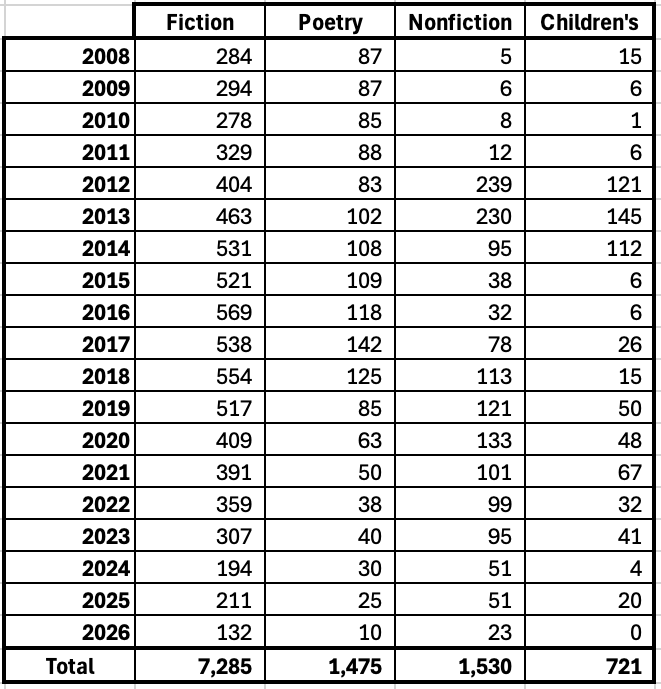
Woof. Those numbers for children’s books are more uneven than the Buffalo Bills defense in a playoff game. Seeing this is good motivation to fix those up and do a whole post just on children’s books in translation.
But first, for everyone whose eyes glaze over when looking at columns of numbers:
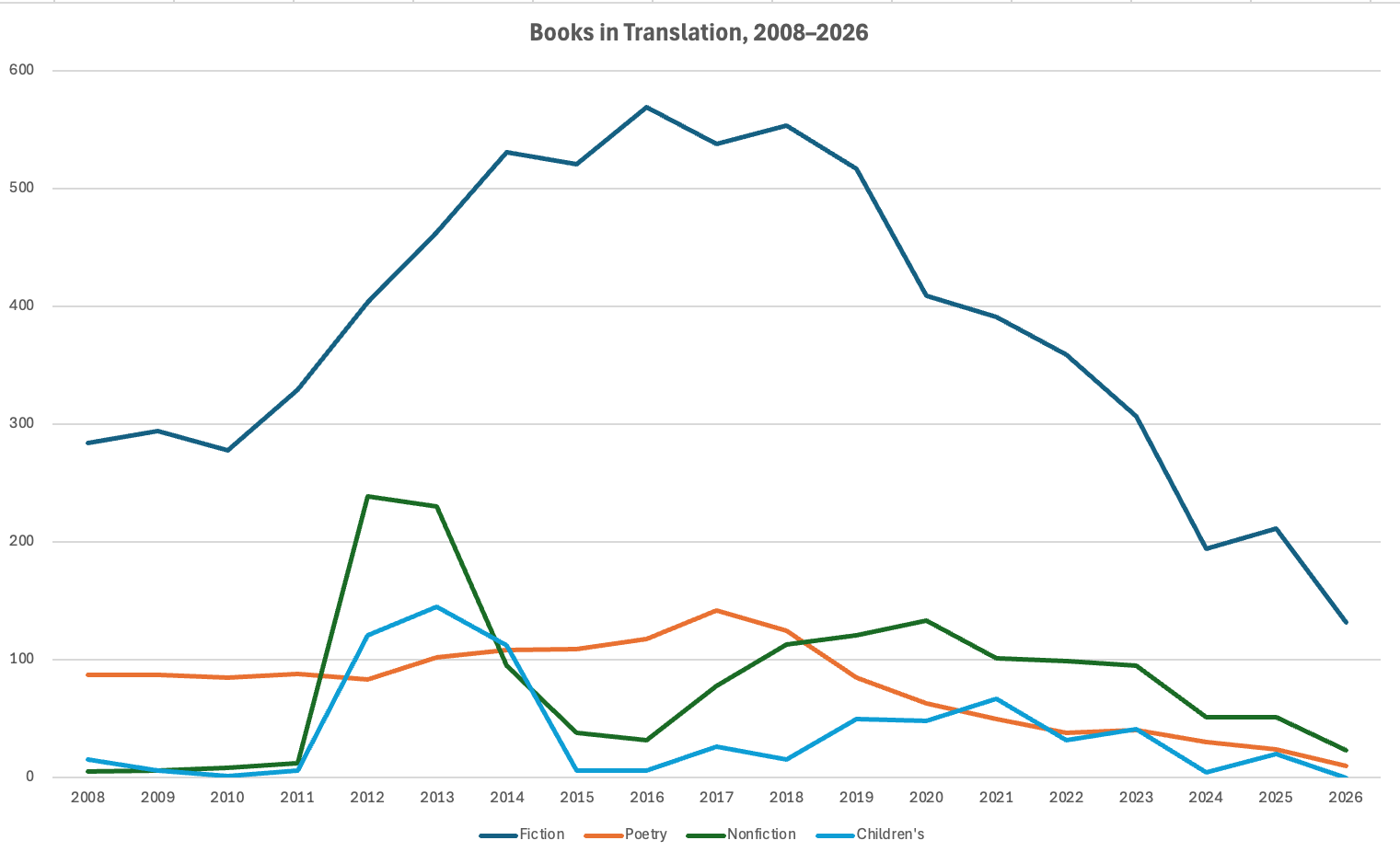
Although I wouldn’t be shocked if the number of publications of literature in translation truly did dip post-pandemic, this is rather extreme. A good chunk of it is probably because, prior to 2020, I relied heavily on physical books arriving in my office from presses whose books weren’t always reviewed in Publishers Weekly, or whatever. At the time everything in the Translation Database was eligible for the Best Translated Book Award, but when that went on hiatus, the number of daily packages petered out.1
If you’re a publisher and want to make sure your books are included, look through the Database (currently sorted by Publisher to make this easier to scan) and add whatever’s missing here. If you’d prefer the actual FileMaker Database populated with all of this, just hit me up. And FYI: All of this data will be up at the University of Rochester Library in a much more searchable format very very soon.
Quick note before we go further: The Translation Database only includes works published in translation for the first time ever (retranslations are excluded) and made available in America through normal sales channels (UK-only titles are excluded). It’s not perfect, but my goal has always been to identify new books, new voices, and new presses—not generate a list of retranslations of classics.
In the greater scheme of things, 11,0182 is still a pretty small data set, but when it comes to books, this is mad overwhelming. During the translation publishing peak (2014–2018), a minimum of 2,713 works of fiction in translation came out—and over a 1,000 other translated works of poetry, nonfiction, and children’s books. Even if you read 100 titles a year (admirable!), you’d spend 27 years just working your way through that subset of a subset of the Database. Data curation is one reason why things like “The Millions’ Great [Insert Season] Preview” are so necessary and popular. (Although given that The Millions hasn’t included an Open Letter title in years raises the question of just how valuable and exciting these previews are. Kidding, kidding, but, really? Not one book?) Decision fatigue is real, and stressful. It’s hard enough choosing a TV show to watch from the ever-morphing Netflix home screen—the idea of picking a book to read off of this entire spreadsheet? Nightmare.
So let’s narrow the data down a bit and see what pops. First up: fiction sorted by translated language.
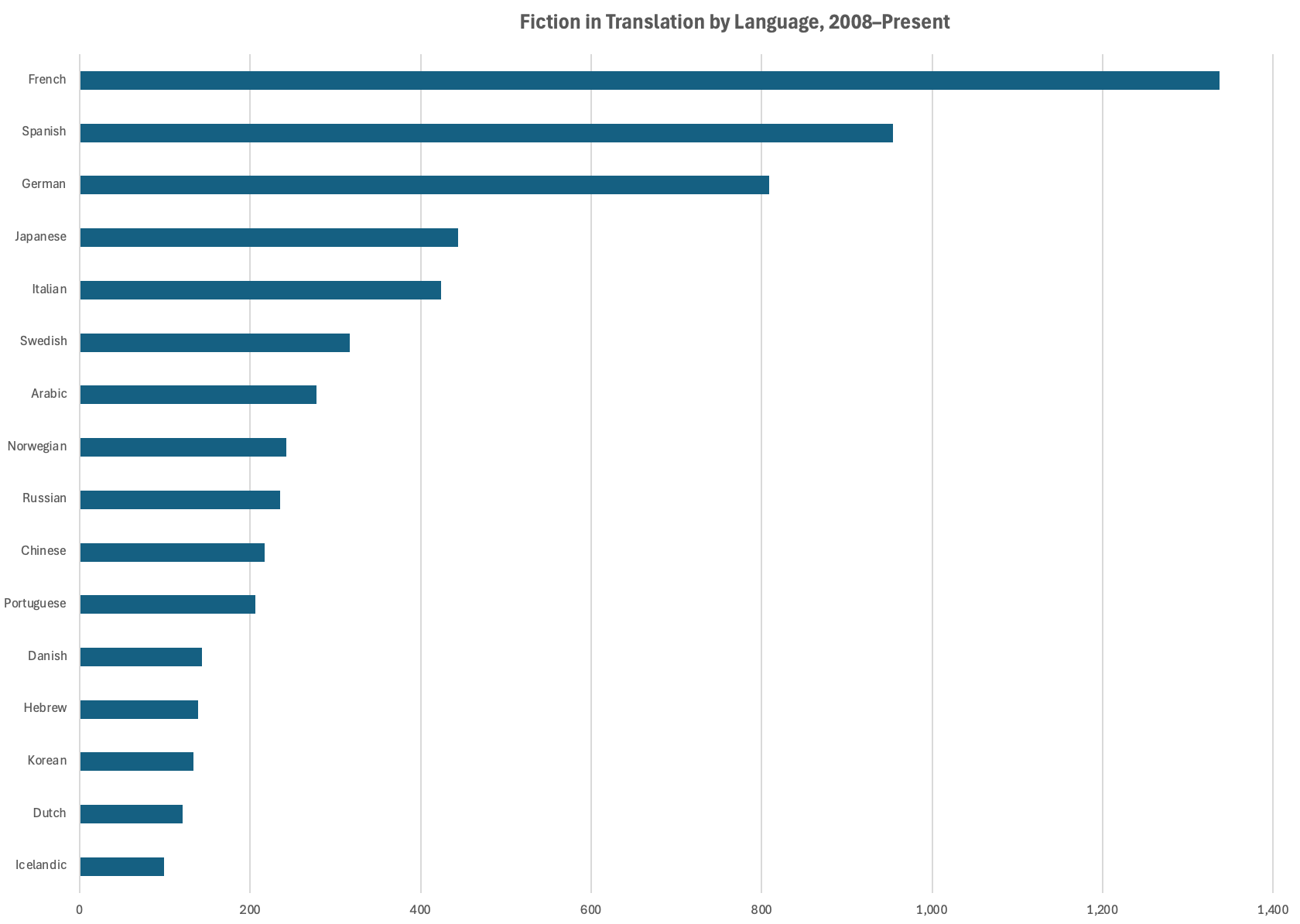
That’s not the most readable chart you’ll see on the Internet today, so here, a bit more plainly, are the top ten most translated languages for fiction published since 2008:
French (1,337)
Spanish (954)
German (809)
Japanese (444)
Italian (424)
Swedish (317)
Arabic (278)
Norwegian (242)
Russian (235)
Chinese (217)
To put this in context, French-language literature accounts for 18.4% of all fiction translations over this period. Even more stunning is that 42.6% of all translated works of fiction are from one of three languages: French, Spanish, or German.
To contrast that data overwhelm, I literally, truly literally, just got this text from one of my Two Month Review co-hosts, Brian Wood, with regards to next season’s book, I, The Supreme by Paraguayan author Augusto Roa Bastos: “During the break, do you think it’d be helpful to read something on Paraguay or go into it cold?” Just for fun, I checked the Database and turns out there’s exactly one book from a Paraguayan author logged: the poetry collection Dream Pattering Soles by Miguelángel Meza, translated from the Guaraní by Elisa Taber and published by Ugly Duckling Presse. One!
Since the Database’s inception, French has been the most translated language, which, to be fair, isn’t at all surprising given the importance of the Parisian publishing scene over the ages, the general respect literary Americans have for French culture, the sophistication of the French foreign rights scene, and, obviously, the surfeit of amazing works of French literature just sitting there, waiting to be translated.
Just as an example, last spring I kicked off a series of posts at the Mining the Dalkey Archive Substack about Dalkey’s “French Obsession” (and mine, I suppose, seeing that I’ve acquired/edited/published/promoted at least 48 books from French over the course of my career, which ain’t bad) and ending up writing, podcasting, or otherwise posting about Raymond Queneau, Jean-Phillipe Toussaint, Jean Echenoz, Pierre Albert-Birot, Christine Montalbetti, Nathalie Sarraute, Sébastien Brebel, Violette Leduc, Laura Vazquez, and Raymond Roussel. All amazing writers, yet barely scraping the surface of what’s out there.
Now before I get carried away with excitement about who is publishing which French books from where, I would be remiss if I didn’t at least mention two major figures in the French literary scene who we’ve lost over the past couple of months: translator, scholar, and biographer David Bellos who passed in October, and super-agent Georges Borchardt, who left us last week.
From Bellos’s translation of Life, A User’s Manual by Georges Perec to Borchardt’s representation of Beckett, Duras, and Éditions de Minuit, etc., these two men contributed immensely to the shape of French literature in translation over the past fifty-plus years.
R.I.P. to two legends of the literary world.

Pietr the Latvian by Georges Simenon, translated from the French by David Bellos (Penguin UK/Picador)
There are a ton of David’s translations worth reading, but if you’re looking for something quick and fun, look no further than Pietr the Latvian. This is the first of seventy-five Inspector Maigret novels—all of which have been reissued in new translations from Penguin UK—and David’s retranslation was made available in the US just this past year.
I actually had the pleasure to heard David speak about this translation way, way back in 2012 at Middlebury College during a conference on “Translation in a Global Community.” My one takeaway of his keynote was David’s plan to restrict himself to translating this book in the same amount of time it took Simenon to write it—something like 14 days. (Simenon was a maniac. But speed is key to writing over four hundred novels during your lifetime.) Most all the details of David’s speech are vague in my aging mind, but I seem to remember that one result of this self-imposed, quasi-Oulipan constraint was that it forced him not to worry about finding the perfect word or phrase. If you’re translating at Simenon Speed, you don’t have time to fret about a comma—you just keep plowing ahead. That’s fun! It feels raw and sort of dangerous.
Another thing that’s fun are the titles David proposed for this book. From a World Literature Today interview:
Well, I did retranslate one book: Georges Simenon’s Pietr the Latvian (1931), the first of the detective novelettes to feature Inspector Maigret. But I treated it as a new translation; I’ve not looked at the version that was done in the 1930s even now. My one regret is that the rights-owner and the publisher didn’t allow me to use either of my two favorite titles, Baltic Pete and Riga Mortis.
Riga Mortis deserves all the groans, but hell yes to Baltic Pete!!
Back to those 1,337 works of French fiction in translation . . . One question to ask of the data is—who’s publishing all these books?
Europa Editions, for one. They’ve brought out at least 112 works of French literature since I started gathering this data, which is almost double the number from Other Press, who has published 68. The rest of the Top 10 is pretty predictable: Seagull Books, Dalkey Archive Press, Gallic Books, AmazonCrossing, Wakefield Press, Snuggly, Archipelago, New York Review Books.
Given that 2008 is a totally arbitrary date, and that various presses have come into existence (or faded away) over the past eighteen years that I’ve been gathering this data, I think it makes sense to narrow my scope a bit. Since ten is a nice round number, and should be fairly representative of what’s happening in book culture today, let’s zoom in on the 777 works of French fiction in translation published between January 1, 2016, and December 31, 2025. That’s a little more manageable.
Here’s an updated breakdown of biggest presses for French fiction in translation over the past decade:
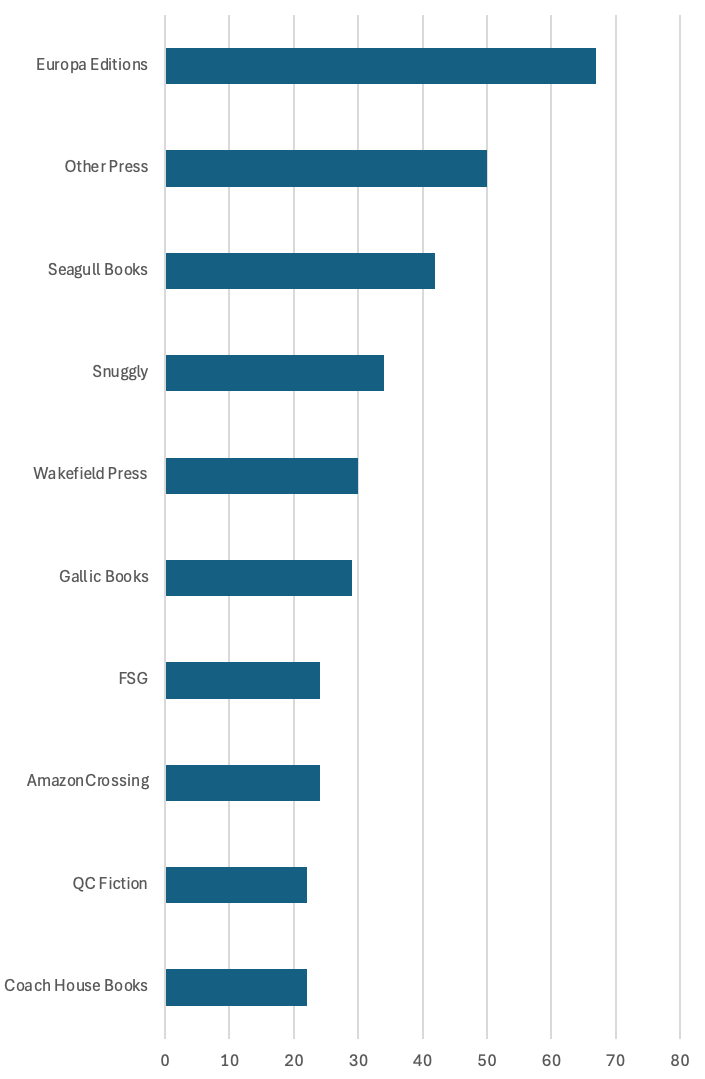
I haven’t updated Snuggly or Gallic Books in quite some time, so their numbers might jump, but all respect to Wakefield Press, both for being on here, and for being one of the straight up coolest presses around. The fiction they bring out is strange in the best of ways, from authors frequently obscure and writing oddball books from the margins, and the objects themselves—well-bound, durable books with French flaps and intriguing covers—are unquestionably gorgeous and produced with care.

The Messengers by Georges-Olivier Châteaureynaud, translated from the French by Edward Gauvin (Wakefield Press)
A bit of Beckett, a bit of Kafka, The Messengers is such an evocative, hallucinatory book. It’s only the second of Châteaureynaud’s to make its way into English (A Life on Paper being the other), which is a true shame. I’m still trying to sort my thoughts on this seemingly metaphoric novella about a messenger who spends their life chasing down the person they’re supposed to deliver a mysterious package to, but I can say that it was gripping and reminded me of a David Lynch movie at times. There are many cages in this book, and a lot of fire.
And in terms of Wakefield Press, Edward Gauvin gives them the nicest of shout outs in his introduction:
Over the past decade, Wakefield Press, taking up the mantle from such stalwarts as Atlas Press and Exact Change, has steadily, surreptitiously curated a catalog of “overlooked gems and literary oddities,” the obscure and forgotten, yet, but also the eccentric, orphaned, and unbeloved—grotesqueries, railleries, and hauntings; ironies, idleries, and irrealities. What better home for the French fantastic? By reinventing literature, we reinvent nations. By making new work available, we create new readerships, and teach readers, old and new alike, to read differently. This body of work deserves to be brought to light; a lost continent with global appeal. Just as fantasy itself can speculate in alternate histories, so Francophone fabulism presents an underside to standard twentieth-century histories, eschewing the usual literary and critical landmarks.
Going back to the list of Top Ten French Fiction Presses above, the other thing that jumps out is the presence of QC Fiction and Coach House Books, both of whom primarily publish French-Canadian works. There is so much great Quebecois literature being written, and, for reasons best explored in a different post, Canadian presses seem to be the only presses paying attention. The Top Five publishers of French-Canadian literature are: QC Fiction (22), Coach House Books (17), Biblioasis (12), Talonbooks (12), and Book*hug (9). (Not coincidentally, these are the same five Canadian presses I can name off the dome.)
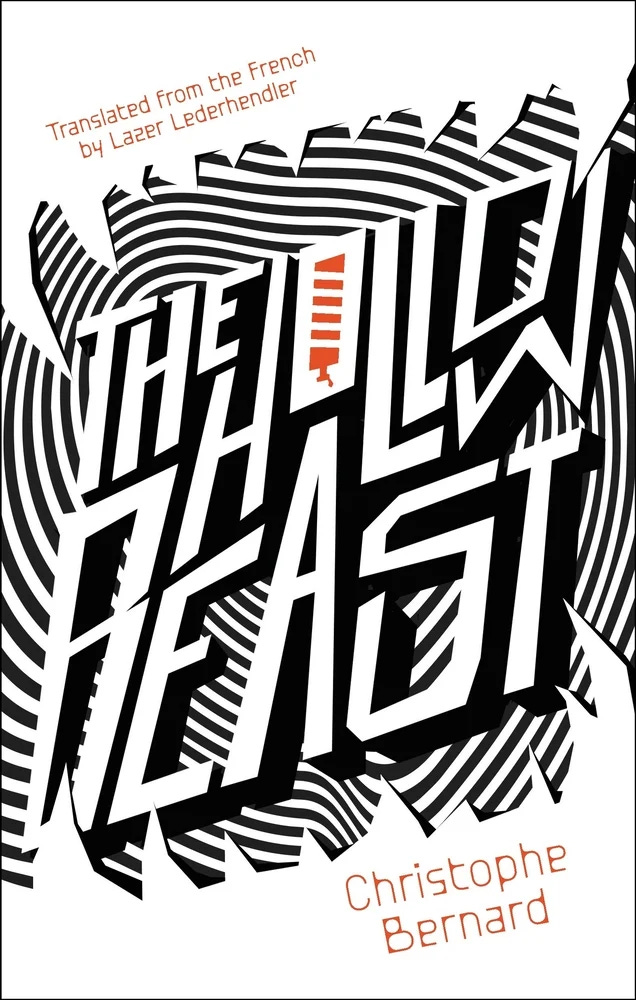
The Hollow Beast by Christophe Bernard, translated from the French by Lazer Lederhendler (Biblioasis)
All I Know About This Book: a) former Open Letter intern, podcast guest, BTBA judge, and all around literary dude (and New England Patriots fan) P. T. Smith turned Dan Wells at Biblioasis onto this book, and b) it’s about hockey. Also: it is long. 616 pages of long. It also has a killer first line:
It wasn’t a good idea for Monti Bouge to just up and declare war on the postal service.
OK, we’ve looked at French fiction as a whole, and French-Canadian writers, but what about the rest of the world? There are dozens of former French colonies with robust literary scenes, and it’s my impression there are more and more books coming out from French writers born outside of France. That might be recency bias at play, since I spent so much time with Seagull’s and Deep Vellum’s catalogs this weekend . . . But it would be interesting, culturally and from a publishing point of view, if there has been an increase in literature from Francophone countries coming out in English. One of the goals of publishing literature in translation is to introduce readers to new voices from all over the world, and with the increased interest in reading a book from every country in the world, and highlighting books from more “exotic” locales, presses would be smart—from both a humanitarian and financial perspective—to focus on French writers not from France.
Before figuring out if there are any signs this is true, let’s look at who has been bringing out these non-France born, French authors over the past decade:
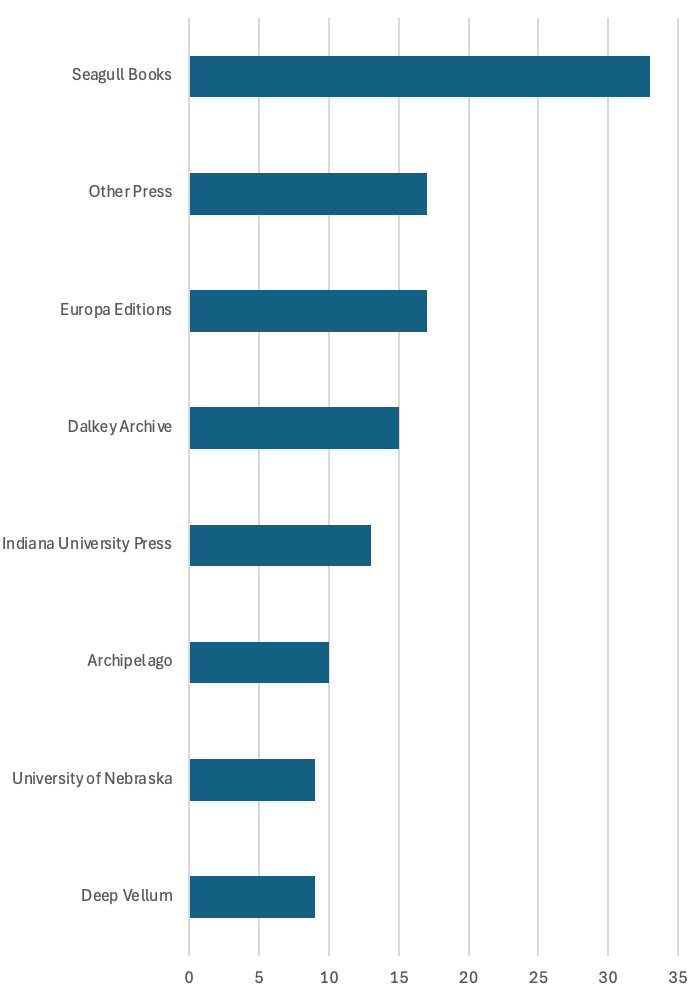
There are only 290 titles fit that category (French fiction, authors born in France and Canada excluded), which screams both “small sample size” and “hey, I could read all of these!” And in terms of where these authors were born:
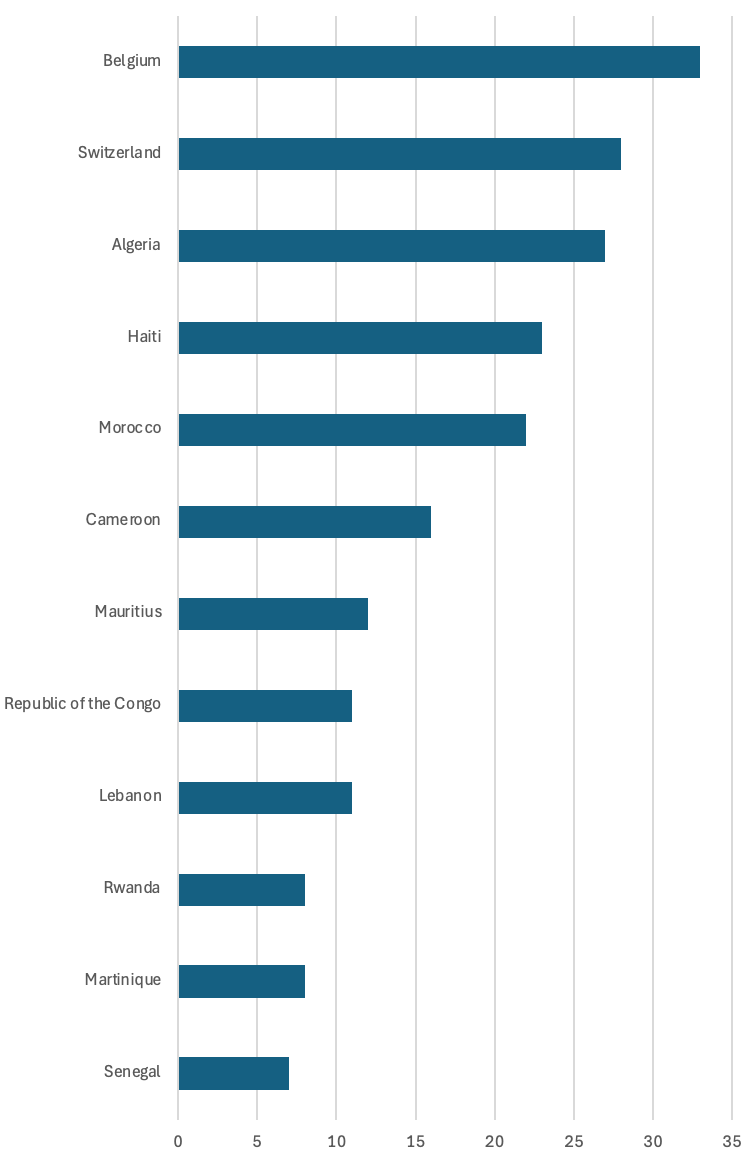
It’s not necessarily surprising that Belgium and Switzerland are on top of this list, but to be completely honest, those weren’t the countries I had in mind when I started parsing this data. But it does explain why Dalkey Archive ranked so high . . . Although they’ve done one book each from Tunisia (Talismano by Abdelwahab Meddeb, tr. Jane Kuntz), Algeria (Confessions of a Madman by Leïla Sebbar, tr. Rachel Crovello), and Canada (Atavisms by Raymond Bock, tr. Pablo Strauss) the other 63 French books from Dalkey Archive in the Database are written by European-born French authors.

Return by Raharimanana, translated from the French by Allison M. Charette (Seagull Books)
This is one of only three books in the Translation Database from Madagascar—all of which have been translated by University of Rochester MALTS graduate, Allison M. Charette. (The other two books are Return to the Enchanted Island by Johary Ravaloson and Beyond the Rice Fields by Naivo.)
About Return:
This evocative novel from a great figure of Malagasy literature tells the story of Hira, a writer born on the seventh anniversary of Madagascar’s independence. He wanders through different cities on a book tour, but the experience is amnesiac and confusing. There is a past he is trying to reckon with, filled with violence against both his family and country. He runs from his wife and represses his memories until it all explodes in fever dreams and a vomit of words. But to write the rebirth that he yearns for, Hira must write of his father’s torture, his tortured island, and how both were juxtaposed to his own happy childhood. In combing through these various pasts, he might make the same mistake his father did: trying to change the world but leaving his own family broken.
Next month, Allison will be on the Three Percent Podcast to talk about Return and Malagasy literature generally, so stay tuned!
One final chart, one final recommendation . . . This is my real attempt to figure out if the “spread” of French literature has changed over the past couple decades. To restate what’s above, my hypothesis (and I’m writing this before running the data) is that there’s a lower percentage of French authors from France being published today than in the early days of the Database. I’m basing this almost entirely on vibes, but to try and rationalize my prediction, I think any shift in balance as to where the French fiction in translation is coming from is due to the confluence of three things: 1) the emergence of a number of prominent translators like the aforementioned Allison Charette, like Jeffrey Zuckerman, who regularly pitch works from authors born outside of France; 2) new publishers coming into existence that are both interested in literature in translation and open to doing works from more “exotic” locales; and, 3) a general shift in interest away from France and toward literature from former colonies and protectorates as evidenced in the increasing number of books from these countries showing up on longlists for various translations awards. All this is perceptual—I haven’t analyzed any longlists, I haven’t done any other research, it’s all based on a feeling and/or cognitive bias.
To figure this out, I’ve separated all French books in the database (fiction, nonfiction, poetry, children’s books) into three groups based on the author’s birth country: France, Canada, and Other. Pretty self-explanatory. The chart below is the percentage of French titles from each of those categories, by year, from 2008 through 2025 on a 3-year rolling average, which smooths out the extremes due to the small numbers of it all.
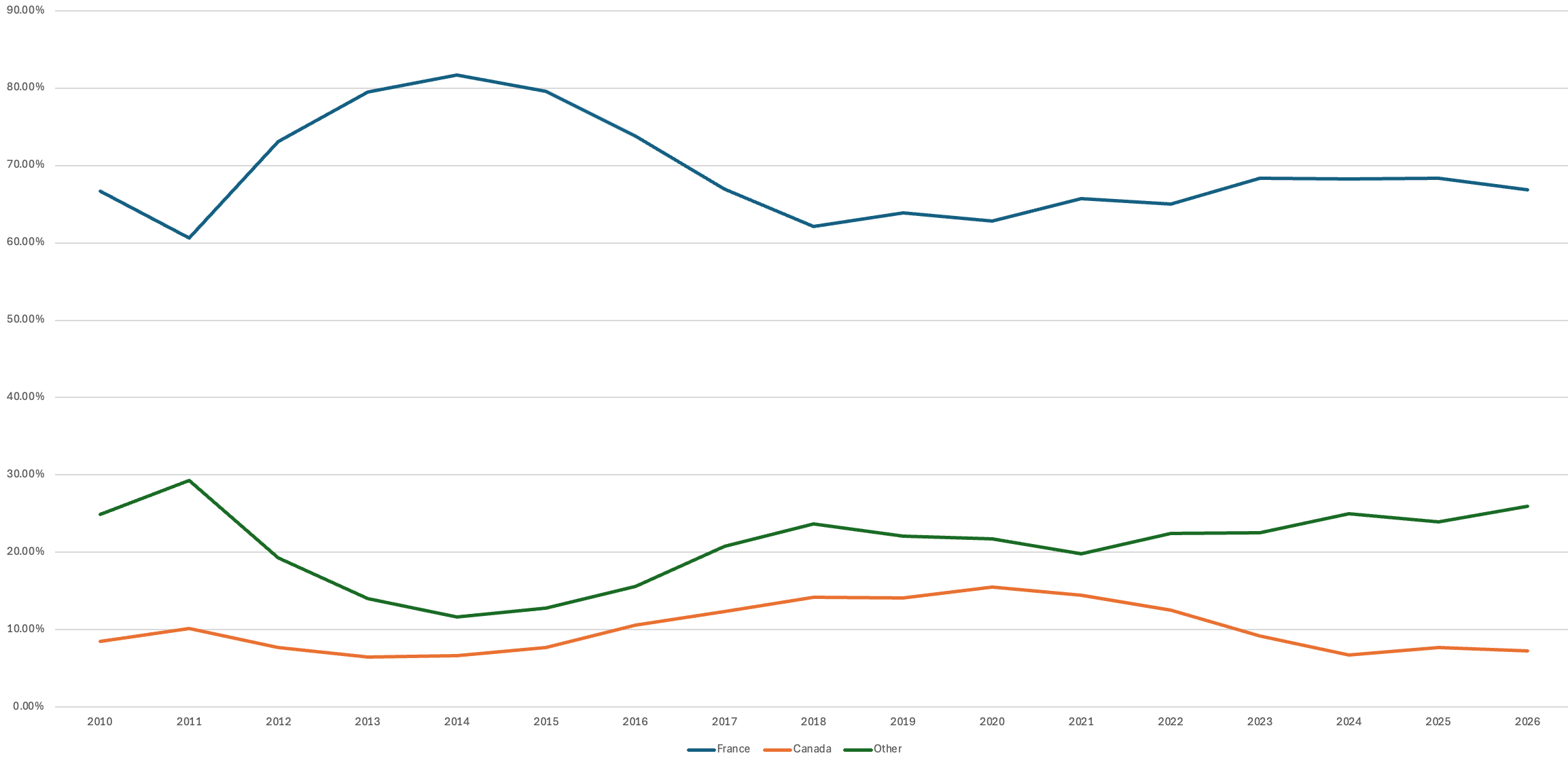
Well, that’s disappointing. I was hoping for something much more dramatic, but, its true that if you start with 2013–2015 and compare it to the present, things have shifted by about 14%, with France-born authors making up almost 82% of the titles from 2012–2014, before dropping to 68% today. So, maybe I’m right? Or, that “peak period” back in the early 2010s was a sort of blip? It’s hard to say, but outside of that bump, things are . . . pretty stable? Alas. Welp, maybe this chart provides a rationale for more editors reshifting their focus a bit? I mean, if it’s important to your brand, you can become the biggest publisher of the literature from almost any non-France, French-speaking country with a little gumption, a few emails, and a modest investment.
Anyway, let’s end with some poetry.

The Hand of the Hand by Laura Vazquez, translated from the French by Limited Connection Collective: Shira Abramovich and Lénaïg Cariou. (Ugly Duckling Presse)
This is a book I came across in the Translation Database when I was looking up Vazquez’s other book, The Endless Week, which came out from Dorothy last year, and has been showing up on a lot of year-end “best of” lists. The Hand of the Hand also came out in 2025, and is an exquisite object—as to be expected from UDP. This collection has also received a lot of great praise:
This remarkable and subtle poetic series moves continually outward—one thing leads to another and another, gaining momentum until its evocations achieve a true fusion of body and world. Whether through forests, ants, stones, or words, it’s a fusion that allows the reader, too, to become one with the world as a unified gesture, and it’s the hand—as bridge, as touch, as grasp—that animates this gesture, this hand that seems ubiquitous, which, in fact, it is. The Limited Connection Collective has captured it all in their superb translation and framed it with a particularly insightful introductory note.
—Cole Swensen
I wasn’t familiar with the Limited Connection Collective before this, but I love the vibe as expressed in this bit from the note Cole Swensen alluded to:
The more we think about it, the more we like to see translation itself as sleight of hand, slipping one language for another, or un jeux de mains, a hand-clap game. Both these expressions bring the body back into the translation process. They gesture towards the collective action of translation, with our hands as the link between our bodies and our languages. Indeed, translating collectively is first of all an experience of gestures, particularly when the translators’ mother tongues differ: when words escape us, hands do what language cannot.
And because I think it makes a fitting ending, here’s a bit from one of Vazquez’s poems:
Things always begin
like this.
Stories.
Books.
Songs.
Prayers.
Ideas.
Functions.
Objects.
Hairstyles.
We’ll be back soon with more data, book coverage, podcasts, and an excerpt from Rusana Bardarska’s To Essay. But in the meantime, please take advantage of our massive site-wide sale: All Open Letter titles are 40% off through January 31st. Time is running out, so stock up now!
To presses like Circumference Books, Ugly Duckling Presse, Archipelago Books, World Poetry Editions, etc., who already send hard copies—thank you! If anyone else is willing and able to send along review copies, Open Letter’s mailing address is: University of Rochester, Morey Hall 303, Rochester, NY 14627.
I know the total above is only 11,011—the other 7 titles are from 2027 and 2028, so I cut them from the chart.
Very intriguing view of the landscape I would not have encountered elsewhere; thank you. I work on a few translated books from French for Schaffner Press a year, and they are especially strong in African Francophone new fiction.
Sooooooo many books to add to my TBR pile. I'm going to have to live to at least 300 now! (Thanks, Chad--this was super interesting!)